My editor is chiding me for the hyperbolic title, as she munches on a bowl of strawberries, grown hydroponically in some cave in Afghanistan and shipped lickety-split to a nearby grocery store for her immediate pleasure. The modern agro-business model never ceases to easily defeat the malleable mind of today's consumer.
Yesterday, and the day before, you were told--no, you were exhorted--to eat your fruits and vegetables. Fruits and vegetables are healthy, full-stop. Every third grader knows that.
So, what's wrong with fruits and vegetables, he said rhetorically, knowing he would soon answer his own question. Other than phytates, lectins, oxalic acid, tannins, saponins and trypsin inhibitors...nothing, really. Welcome to the whimsical world of anti-nutrients.
 |
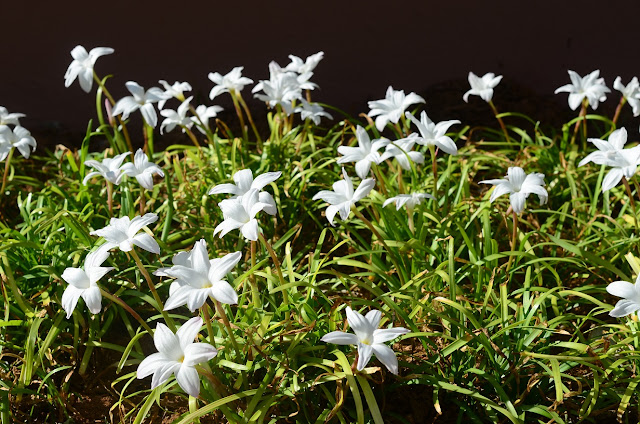
| Musa paradisiaca is the most common banana in Bermuda gardens. |
 |
| Passiflora edulis |
The well-guarded secret is that plants don't want to be eaten. Fancy that. Fruits and vegetables are loaded with nasty though protective (from the plant's point-of-view) compounds that are likely to give you a tearful tummy ache (and when I say you, I mean any critter on God's green earth that might fancy a chew on some salubrious leaf or want to feast on bright red berries. As humans we tend to think the world revolves around us. But it doesn't. Speaking frankly, nature might want you (or some creature) to eat fruit as a means of seed dispersal. And without venturing too far into scatological matters, I will explain tactfully: you eat the fruit; said fruit passes through your digestive tract (elephants and baboons, too) and lands, somehow, in a comely patch of dirt, whereupon it germinates.
Another problem is that the fruit you gorged on was probably never intended for you. Nature probably had a particular species of bird in mind to co-opt into scattering the seeds, free of change, as farm labor is so expensive. And so, the reason some fruit may not agree with you is that the plump berry you popped into your mouth was never meant for you. But we are egocentric and regularly dismiss the incontrovertible evidence that we share the planet with other hungry animals.
But one thing is certain: natures does not want you--or any other of its vast network of crazy-eyed critters--to eat seeds. Seeds are for germination, not for chewing, masticating, or offering up on the altar of Epicure. This means you probably ought not eat sunflower seeds, pumpkin seeds, sesame seeds... You get the idea. Strawberry seeds and the like, however, are the exception (such a clever design). They are so small that they escape their tormentor's teeth--and end up at the other end, unscathed--though meticulously malodorous.
And if mother nature, that free-spirited termagant, doesn't want you to eat her seeds, she doesn't see much point in you eating leaves, twigs, roots, or whatever--as she has armed her verdant vassals with a pharmacy of potent defenses (those annoying anti-nutrients).
Should you then not eat fruit and vegetables? No. But simply this: don't assume plants are benign. Ricinus communis ( castor bean plant) is a friendly-looking plant. If you are a Soviet-era spy (and I happen to know some of my readers are) you will know that the particular lectin from the castor bean, called ricin, can kill you in a heartbeat. Benign. Not so much. The blanket statement that plants are good because they are natural is not endorsed by most spy agencies.
The castor bean example too extreme for you? What about kidney beans? Heard of those? Eating as little as four uncooked red kidney beans (Phaseolus vulgaris) can land you in the hospital with diarrhea and vomiting. Cases are well documented. Cooking deactivates the lectins in kidney beans making them safe to eat. Phew!
In Bermuda, we are fond of cassava pie, made with unconscionable amounts of butter, half a hen house worth of poultry, stray feathers, some pork, a crazy amount of eggs, and cassava flour. Raw cassava contains cyanide and must not be eaten. Again, the cooking is the key. Not all anti-nutrients are destroyed by heat, so there's something else for you to chew on. [Nice metaphor. Ed.]
My aim is not to malign plants. If you prepare lionfish ( with its venomous spines) improperly, you could be in for a surprise. Venomous defenses are not the same as the biological warfare employed by plants to keep you from feasting on them; nevertheless, don't mess with a lionfish. But as far as anti-nutrients are concerned, there are indeed lectins in meat, though they are far less troublesome to the human digestive enterprise than the don't-eat-me chemicals found in plants.
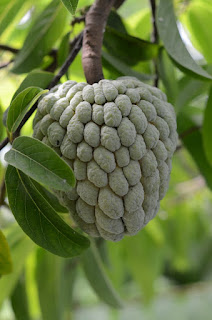 |
| Annona Squamosa also called Sugar Apple |
But we are drifting from the topic in hand: fruit. I grow Sugar Apples and love them. They are members of the Anonnas, or custard apple family. They also contain neurotoxins. Bottom line, don't eat a crate of them.
There are lectins in tomatoes, carrots, rice, barley, navy beans, cantaloupe, lemons, bananas, garlic, and cocoa. And that's a very incomplete list. Lectins are a favorite way plants protect themselves against invaders (caterpillars, lawyers, accountants, etc) but there are others, the razor-sharp edges of oxalate particles, for instance: how would you like to swallow a 12 pack of Gillette razors?
An eloquent elk can run away from you or knock you down--and trample on your head. Plants are unable to defend themselves in this manner; therefore they need to resort to other means (some of which have been cataloged here).
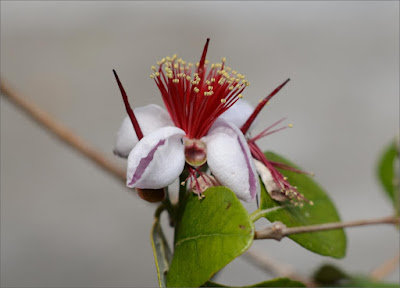 |
| Acca sellowiana. My Feijoa tree was murdered bt Humberto in 2019. |
Plants undoubtedly possess beneficial compounds, but one should never conclude that they are unquestionably healthy. Spinach, for example, is a treasure trove of calcium and magnesium. But what good is that if the oxalates found in Popeye's favorite food prevent humans from absorbing those minerals? Aside from being inflammatory--funny how swallowing sharp objects will cause that--oxalates bind to essential minerals making them unavailable.
So what is my recommendation on fruit? Eat fruit in season. This necessarily limits your intake. It also puts you into synchronicity with the way in which your ancestors (say of a couple million years ago) ate. They were the original intermittent fasters, and this probably conferred some metabolic advantages--which we sadly have lost with our 24 hour access to the Seven Eleven slurpees and foot long franks.
Vegetables? Eat what's in season... Same reasons.
Here are a couple of fruits growing under the pandemic skies of June.
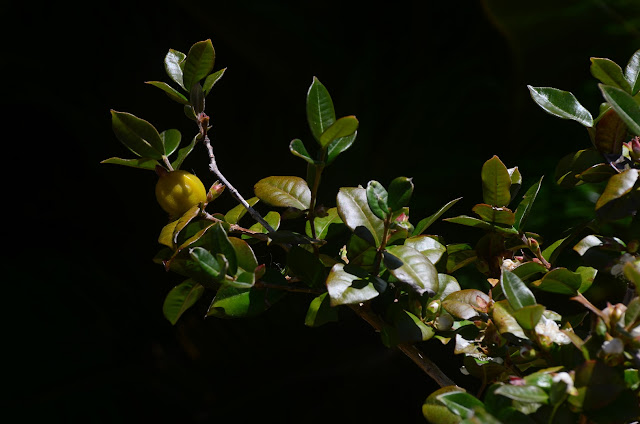 |
| Eugenia selloi |
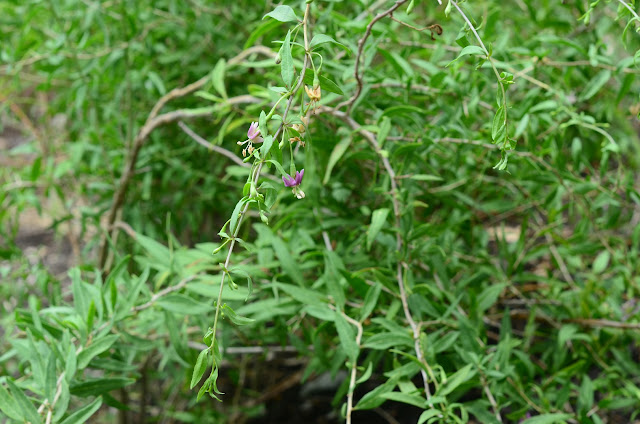 |
| Goji |
I love goji berries. They are, however, part of the Nightshade family--but that's a whole other subject.